
Fapes Universal 13/2025
IA no Ensino Superior: implicações para a geopolítica da produção de conhecimentos e diversidade de línguas do e no Sul Global
Resumo
Com a crescente aderência da inteligência artificial (IA) na sociedade como um todo, e no ensino superior, em particular, as universidades são convocadas a liderar o uso crítico e ético dessa tecnologia que pode mudar o destino da humanidade. Considerando a universidade como o local privilegiado para a produção do conhecimento científico em prol do avanço da humanidade, o ensino superior deve liderar as pesquisas sobre os impactos do uso da IA orientando seu uso ético e crítico para fortalecer a missão da universidade de produzir conhecimentos socialmente relevantes, bem como o desenvolvimento de novas soluções para problemas locais e globais. O engajamento crítico das universidades na pesquisa e orientação de uso da IA é essencial para garantir que a produção científica mundial seja pautada por princípios de equidade, inclusão e diversidade linguística e epistemológica. Este projeto de pesquisa investiga as implicações do uso da IA generativa (GenIA) como grandes modelos de língua (Large Language Models – LLMs) que processam e entendem linguagem natural em larga escala – na geopolítica da produção do conhecimento mundial focando em implicações para e questões de acesso, visibilidade e inovação do conhecimento produzido no Sul Global em outras línguas além do inglês especialmente em português e espanhol. Com base em estudos recentes que destacam os riscos da brecha digital e hegemonia do inglês com consequente exclusão epistêmica de conhecimentos produzidos no Sul Global e em outras línguas, o projeto explora como o uso da IA faz intersecção com a diversidade linguística e epistemológica da produção do conhecimento em relação às assimetrias de poder entre Norte e Sul Global e a produção de saberes oriundos de regiões e línguas sub-representadas. Usando uma abordagem de métodos mistos que combina análises qualitativas e quantitativas de dados coletados por meio de técnicas bibliométricas, entrevistas, surveys e estudos de caso contrastivos de políticas e práticas institucionais para o uso de IA, esta pesquisa busca lançar luz sobre as dimensões linguísticas e geopolíticas da IA no ensino superior. Iniciativas de Intercâmbio Virtual (IV) serão realizadas entre os participantes do projeto, vinculados a universidades do Sul e do Norte Global visando fomentar a colaboração internacional por meio do IV bem como a produção de dados em colaboração internacional amplificando vozes marginalizadas para subsidiar políticas e práticas de produção de conhecimento usando a IA de forma mais crítica e equitativa no ecossistema de produção acadêmica global.
Palavras-chave: Inteligência Artificial, Ensino Superior, Sul Global, Diversidade Linguística, Inclusão Epistêmica, Intercâmbio Virtual, Colaboração Internacional
AI in Higher Education: implications for the geopolitics of knowledge production and language diversity in and from the Global South
Abstract
With the growing adoption of artificial intelligence (AI) in society as a whole, and in higher education in particular, universities are called upon to lead the critical and ethical use of this technology that can change the fate of humanity. Considering the university as the privileged place for the production of scientific knowledge for the advancement of humanity, higher education should lead research on the impacts of AI use, guiding its ethical and critical use to strengthen the university's mission to produce socially relevant knowledge, as well as develop new solutions to local and global problems.The critical engagement of universities in AI research and guidance is essential to ensure that global scientific production is guided by principles of equity, inclusion, and linguistic and epistemological diversity. This research project investigates the implications of using generative AI (GenAI) - such as Large Language Models (LLMs) that process and understand natural language on a large scale - in the geopolitics of global knowledge production, focusing on implications for access, visibility, and innovation of knowledge produced in the Global South in languages other than English.Based on recent studies that highlight the risks of the digital divide and the hegemony of English with the consequent epistemic exclusion of knowledge produced in the Global South and in other languages, the project explores how AI use intersects with linguistic and epistemological diversity in knowledge production in relation to power asymmetries between the Global North and South and the production of knowledge from underrepresented regions and languages. Using a mixed-methods approach that combines qualitative and quantitative analyses of data collected through bibliometric techniques, interviews, surveys, and contrastive case studies of institutional policies and practices for AI use, this research seeks to shed light on the linguistic and geopolitical dimensions of AI in higher education. Virtual Exchange (VE) initiatives will be carried out among project participants, linked to universities in the Global South and North, aiming to foster international collaboration through VE as well as the production of data in international collaboration, amplifying marginalized voices to support policies and practices for knowledge production using AI in a more critical and equitable way in the global academic production ecosystem.
Keywords: Artificial Intelligence, Higher Education, Global South, Linguistic Diversity, Epistemic Inclusion, Virtual Exchange, International Collaboration
O projeto Internacionalização e Inovação na Educação Superior: Línguas, Tecnologias e Mobilidades foi contemplado com apoio da Fapes Edital Universal 28/2022
Vigência: Nov. 2022/24 meses
Este projeto visa investigar o papel das línguas, tecnologias e mobilidades (física e virtual) no processo de inovação e internacionalização do ensino superior no contexto de e pós-pandemia COVID19, a partir de evidências colhidas em pelo menos três universidades brasileiras (UFES, UFRGS e UFG) e contrastadas com pelo menos três universidades estrangeiras (Coventry na Inglaterra, Valência na Espanha e Malaya na Malásia) com possibilidades de ampliar para mais três universidades estrangeiras sendo uma na Turquia (Gazi) e duas em Portugal (Aveiro e Evora). A análise do papel das línguas, tecnologias e mobilidades (física e virtual) no processo de inovação e internacionalização das universidades escolhidas tem como fim propor um modelo de internacionalização mais inovador, crítico e sustentável para universidades brasileiras em geral e para a UFES e o ES em particular. A fim de alcançar esse objetivo principal, o projeto usará uma metodologia mista triangulando dados qualitativos e quantitativos das universidades pesquisadas por meio da atuação coordenada dos pesquisadores principais e colaboradores sob a supervisão da proponente. Como resultado deste projeto e da análise do papel das línguas, tecnologias e mobilidades nas universidades brasileiras e estrangeiras, espera-se elaborar um modelo de internacionalização inclusivo e inovador para a educação superior brasileira, além de fortalecer a parceria internacional entre as instituições e comunidades envolvidas, contribuindo para a formação de recursos humanos, para o desenvolvimento científico e para a inovação do Espírito Santo em particular e do Brasil em geral.
Equipe do projeto
Coordenadora: Kyria Finardi/UFES
Pesquisadores: Simone Sarmento (UFRGS), Gabriel Amorim (UFG), Franciso José Quaresma de Figueiredo (UFG), Marina Orsini-Jones (Universidade de Coventry, UK), Ana Sevilla-Pavón (Universidade de Valência, Espanha), Azirah Hashim (Universidade Malaya, Malásia), Asuman Asik (Universidade de Gazi, Turquia), Susana Pinto (Universidade de Aveiro, Portugal), Ana Alexandra Lázaro Vieira da Silva (Universidade de Evora, Portugal), Eduardo Diniz Figueiredo (UFPR), Felipe Guimarães (UFES), Marcelo Kremer Universidade de Aveiro, Portugal).
Alunos de pós graduação UFES: Ramon Ortiz (PPGAdm), Claudio França (PPGE), Ana Rachel Macedo Mendes (PPGE), Carlos Alberto Hildeblando Junior (PPGE), Roberta Gomes Leão (PPGE), Elisa Prado Có (PPGE), Barbara Cortat Simoneli (PPGE)
Internationalizing Extension and Extending Internationalization
Acknowledgments are due to Fundação de Amparo à Pesquisa e Inovação do Espírito Santo – Fapes – Call 3/2021 (Fapes Universal) for the period 11/01/21 to 10/ 31/23
Project timeline

Acknowledgments are due to Fundação de Amparo à Pesquisa e Inovação do Espírito Santo – Fapes – Call 3/2021 (Fapes Universal) for funding of Project: Internationalizing Extension and Extending Internationalization/Interiorization for the period 11/01/21 to 31/ 10/24.
The United Nations Sustainable Development Goal 4.7 challenges the university to integrate education for global citizenship as a way to provide learning opportunities for the development of global, national and local (glonacal) citizenship. The objective of this project is to promote glonacal education in the post-Covid context, using technology to place small and medium-sized companies from Espírito Santo, Brazilian and foreign students, teachers and researchers in interconnected relationships, collaborating in the development of teaching, research, extension, internationalization actions in an integrated way with the communities involved. More specifically, the project aims to integrate actions of teaching, research, extension, internationalization of UFES in the development of a “glonacal” citizenship, acting in the exchange/and transfer of knowledge, innovation and technology at UFES with the internal and external community . With this objective, the project aims to integrate actions of teaching, research, extension, internationalization and internalization of UFES and the University of Valencia (UV) in Spain (linked to YES3D project) with the community around small and medium-sized companies in Espírito Santo Santo in order to assist the process of internationalization of these companies, thus promoting the transfer of knowledge and the internalization of research and university extension to the entire community of the State of Espírito Santo. This project is articulated with the Youth Entrepreneurship for Society project in 3D (YES3D) which investigates the role of three-dimensional virtual reality and simulations in contexts of international virtual exchanges between university students of English for specific purposes of the UV in the context of the Processes of formation of future professionals from the business world and, more specifically, from social entrepreneurship based on the Sustainable Development Goals (SDGs) proposed by UNESCO and coordinated by Professor Ana Sevilla-Pavón from UV, with the participation of Professor Kyria Finardi, proponent of this proposal. The YES3D project envisions problem-based tele-collaborative learning and simulations of professional environments in virtual worlds, offering a fertile ground to overcome global and physical barriers meeting the needs of students and citizens of the 21st century. This is especially relevant today in the current context of the pandemic and the need for online training given the imposition of social distancing and the need to develop internationalization and internalization of internationalization in the State. In a context where academic mobility was the privilege of less than 2% of Espírito Santo's academic population before it was suspended due to the pandemic, virtual mobility through simulations of professional virtual environments in virtual exchanges in three-dimensional worlds emerges as a powerful tool for internationalize/internalize teaching, research and extension actions. Virtual mobility has been increasingly adopted to replace and complement physical mobility, providing similar potential benefits to those derived from an academic or professional exchange abroad. This project proposes virtual exchanges between academics from UFES and UFES and Espirito Santo communities to solve problems of interpersonal and intercultural communication added to simulations of professional environments and social entrepreneurship in three-dimensional virtual worlds to help the internationalization of university extension as well as the expansion of teaching, research, extension and internationalization actions for the interior of the State of Espírito Santo.
Brazil team meeting 02/25/2022


Brazil team with Spain 03/15/22

Virtual Reality training "Spatial" 25/03/2022

Professor Finardi met professor Marta Fortes from the University of Limerick Ireland, new VE possibilities for Universal Project team

Associate Teacher in Spanish at the University of Limerick, coordinating Spanish for Business (Advanced) modules in first, second, third and fourth year. PhD research on teaching Spanish for specific purposes through technology, organising projects and virtual language exchanges with international universities in virtual reality environments. Current projects are focused on developing attitudes and values towards sustainable practices amongst business students. Degree in teaching and MA in Applied Linguistics in the University of Limerick.
Part of the Fapes Universal Project and professor Marta Fortes from University of Limerick meeting 10/06/2022



Participation in an international event with partial results of the Universal Project 14/06/22

VE between Fapes Universal team and UV about VR applications on L2


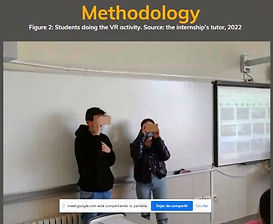
VE the University of Gazi, Turkey-july 2022

Lecture on VE with professor Alun DeWinter

Planning meeting VE UFES/Limerick Irlanda. 14-09-22

Check out the videos:
https://drive.google.com/file/d/1iIgUdubFXPT4afNj8L658hZ2Y5qzBBw8/view?usp=sharing
https://drive.google.com/file/d/1Oq3pEHMACtZao7H7iyEoxuz6JJECQCJ0/view?usp=sharing
Professor Kyria at QS Americas event

Universal Project presentations at I3D event in Spain


I3D event at Universidad Politécnica de Valencia


Company participaiting in the project-check out the video

Videos about Brazil


Guaraná com Chocolate» a Brazilian-Swiss exchange
-
Intercultural awareness through action
-
International cooperation

